HomeCategory

House Building

In a decisive move to bolster the United Kingdom’s infrastructure and stimulate economic growth, the government has unveiled the “Plan for Change“. This ambitious initiative aims to streamline the planning process, accelerate major infrastructure projects, and address the nation’s housing shortage, thereby laying the foundation for a more prosperous future.

Streamlining Legal Challenges to Infrastructure Projects

A significant component of the Plan for Change involves reforming the legal framework that governs challenges to major infrastructure developments. At present, projects can face up to three legal challenges, often resulting in lengthy delays and increased costs. The new plan proposes limiting such challenges to a single instance, thereby reducing the time and resources expended on legal proceedings.

Government data reveals that 58% of all major infrastructure decisions are subjected to court challenges, with each case taking an average of 18 months to resolve. Notable projects delayed by such challenges include the East Anglia wind farms, Sizewell C nuclear power station, and the A47 National Highway Project. By restricting the number of legal challenges, the government aims to expedite project timelines and alleviate pressure on the judicial system.

Image of countryside that could be a target for Plan for Change
Image by Peter H from Pixabay

Accelerating Housing Development Near Transport Hubs

Addressing the housing crisis is a central pillar of the Plan for Change. The government has set an ambitious target to deliver 1.5 million homes within the current parliamentary term. A key strategy to achieve this goal is the promotion of residential development around England’s commuter train stations. By introducing a “presumption in favour of building” and zoning schemes prioritising development near transport hubs, the plan seeks to improve access to jobs and enhance living standards.

Inspired by successful initiatives in cities such as Manchester, these planning reforms aim to reduce bureaucratic barriers and hasten the construction of new homes. Major housebuilders have welcomed these measures, recognising them as a positive step towards more efficient planning and development.

Revitalising the Oxford-Cambridge Arc

In a bid to position the UK as a global leader in innovation, the government has revived plans to develop the Oxford-Cambridge Arc, envisioned as a rival to Silicon Valley. This initiative aims to double the economic output of the region by 2035 through significant investment in research and development. The project has the potential to add £78 billion to the UK economy and has garnered support from key stakeholders, including university leaders and major firms such as AstraZeneca UK and Arm.

However, the plan faces challenges, including local opposition to new developments, housing shortages, and infrastructure requirements. The government has pledged to address these issues, with plans to construct 1.5 million homes and prioritise development to unlock the Arc’s full potential.

Expanding Airport Infrastructure to Boost Connectivity

Improving the UK’s connectivity is another focus of the Plan for Change. The government supports major airport expansions, including a third runway at Heathrow Airport and full-time use of Gatwick Airport’s second runway. These developments aim to increase airport capacity in southeast England, stimulate economic growth, and create jobs.

The proposed third runway at Heathrow involves upgrading existing infrastructure and adhering to environmental standards. At Gatwick, a £2.2 billion investment could operationalise the second runway by the end of the decade, generating substantial economic benefits. Furthermore, Luton Airport’s expansion plans await government approval, aiming to double passenger capacity with a new terminal.

Implementing the National Infrastructure Delivery Plan

The Plan for Change aligns with the objectives outlined in the National Infrastructure Delivery Plan, which details how the government will support the delivery of infrastructure projects and programmes. The plan highlights the importance of both public and private sector investment in achieving the nation’s infrastructure ambitions.

The latest National Infrastructure and Construction Pipeline outlines projected and planned investment over the next ten years, with a total value of £600 billion. This comprehensive approach underscores the government’s commitment to revitalising the UK’s infrastructure and driving long-term economic growth.

On the Plan for Change, prime minister Keir Starmer said: “For too long, blockers have had the upper hand in legal challenges – using our court processes to frustrate growth.

“We’re putting an end to this challenge culture by taking on the NIMBYs and a broken system that has slowed down our progress as a nation.

“This is the government’s Plan for Change in action – taking the brakes off Britain by reforming the planning system so it is pro-growth and pro-infrastructure.

“The current first attempt – known as the paper permission stage – will be scrapped. And primary legislation will be changed so that where a judge in an oral hearing at the High Court deems the case Totally Without Merit, it will not be possible to ask the Court of Appeal to reconsider. To ensure ongoing access to justice, a request to appeal second attempt will be allowed for other cases.”

Melanie Leech CBE, chief executive of the British Property Federation, said: “We can build great infrastructure in the UK – eventually. From power stations to bypasses, we take longer to deliver important national projects than other developed nations, and that has to change.

“If we want to grow the economy and fund vital public services, then we have to better balance environmental and community interests with the benefits of development, and do so in a clear and timely way. Reducing the scope for vexatious and unmerited legal challenges, whilst retaining a right to appeal, is a very positive step in achieving this.”

However, Roger Mortlock, CPRE chief executive, said: “The government should bring people together to tackle the climate emergency, not set them against each other with tired, divisive language.

“Campaigners bringing legal challenges only do so because they think the law is being broken. Allowing judges to block these concerns as ‘totally without merit’ is anti-democratic and, when it comes to the climate crisis, dangerously short-sighted.

“Climate change is the single biggest threat to the countryside. It’s clear we’ve got to build a clean energy grid fit for the future but the best way to achieve this is with local communities involved from the start.

“The UK could learn from countries such as Ireland and Australia, which involve communities in decision making  from the beginning, reducing the need for lengthy and expensive legal processes without eroding democracy. For everyone’s sake, we should be building consensus, not dismissing people with real ideas and solutions as ‘blockers’.”

The Labour Government, under the leadership of Prime Minister Keir Starmer, has outlined a transformative plan to address the housing crisis in the UK. Angela Rayner, Deputy Prime Minister and Secretary of State for Levelling Up, Housing and Communities, has committed to delivering the “biggest boost to affordable housing in a generation,” with ambitious reforms targeting both policy and implementation.

Boosting Affordable and Social Housing

Angela Rayner has pledged to deliver 1.5 million new homes within five years, focusing on affordable and social housing. Key initiatives include:

  • Reinstating Mandatory Housing Targets: Following their abolition under the Conservative government, Labour has reintroduced these targets, aiming to increase housing stock across the country.
  • Prioritising Social Housing: Labour plans to significantly boost council housing and social homes, ensuring long-term stability for local authorities and housing associations.
  • Flexibility in Funding: By reforming the Affordable Housing Programme, Labour aims to unlock government grants and redirect resources to high-demand projects, enabling faster delivery of homes.

Planning System Reforms

To streamline development, Labour’s policy introduces:

  • Simplified Approval Processes: Brownfield land development will be fast-tracked, with a default “yes” to applications that meet planning standards.
  • Targeted Green Belt Development: Some grey belt areas, such as disused car parks, will be repurposed under strict guidelines, ensuring 50% affordable housing and access to essential services like schools and healthcare.
  • Updated Housing Needs Assessments: Calculations for land allocation will use modern data, replacing outdated metrics from 2014.

Accountability for Developers

Labour plans to hold developers accountable for their obligations to build affordable housing. Measures include:

  • Enhanced Oversight: A “Take Back Control Unit” will assist local authorities in negotiating with developers under Section 106 agreements.
  • Transparency in Viability Assessments: Standardised national guidelines will ensure developers cannot evade commitments without legitimate cause.

Balancing Aesthetics and Practicality

Labour has moved away from the Conservatives’ emphasis on “beauty” in new builds, focusing instead on “exemplary” standards for design and functionality. This approach aims to prioritise liveability and sustainability over subjective aesthetic criteria.

Addressing Private Sector Challenges

Labour’s housing strategy also includes reforms for the private rented sector, such as improving tenant protections and ensuring better regulation of leasehold arrangements. These measures are designed to tackle rising rents and insecure housing conditions.

The Long-Term Impact

Labour’s comprehensive housing strategy seeks to address the housing emergency by ensuring a stable, long-term plan. Key stakeholders, including the Chartered Institute for Housing and the National Housing Federation, have endorsed the proposals as a significant step towards resolving the crisis. With 5 million households projected to face unaffordable housing without intervention, Labour’s reforms aim to restore hope for millions across the UK.

Milbank Concrete Products, a leading precast concrete company based in Essex, is proud to announce a ground-breaking achievement in sustainable construction. The company has successfully completed the UK’s first-ever delivery and installation of precast concrete hollowcore floors using 100% renewable Hydrotreated Vegetable Oil (HVO) second generation biofuel.

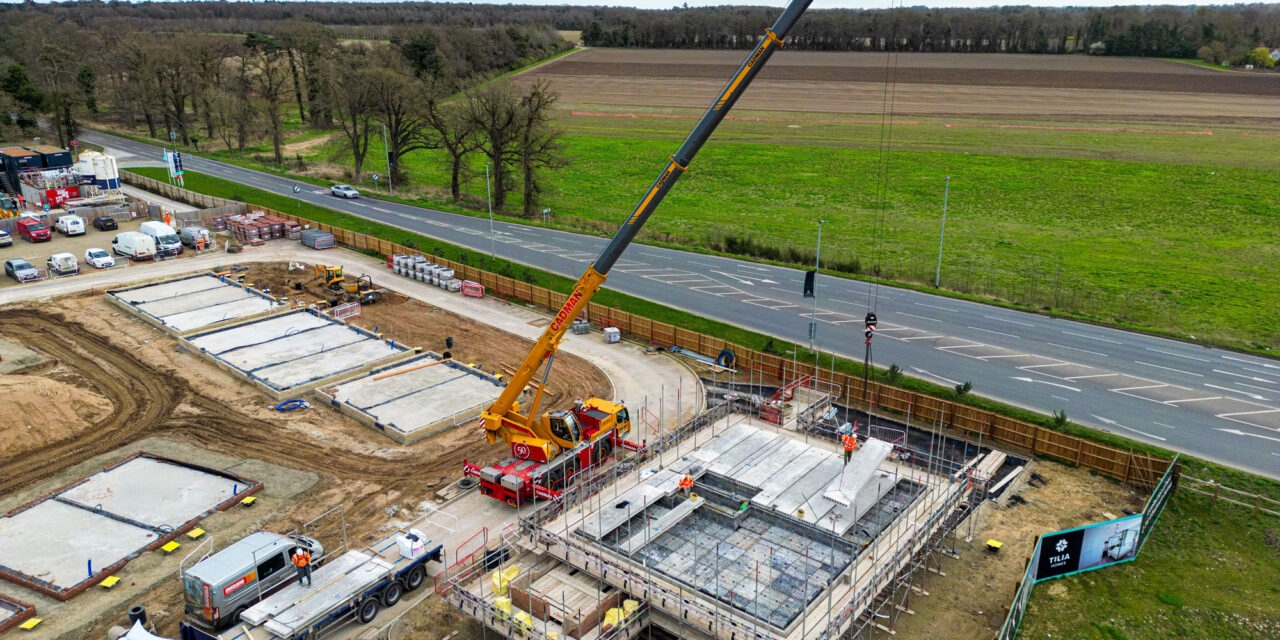
The installation of over 190m2 of hollowcore flooring and 3 flights of precast stairs, on behalf of Tilia Homes located within their Sovereign Gate development in Thetford, marks the UK’s first-ever precast concrete installation using 100% HVO fuel throughout the entire process, from delivery to installation.

Tilia Homes HVO Installation.
Image: Milbank Concrete Products

The delivery lorry (in partnership with Woodland Logistics), the mobile crane (in partnership with Cadman Cranes), and the site team installation van all ran on HVO fuel, a renewable fuel alternative to regular diesel. This innovative approach reduces the project’s installation carbon emissions by over 90% and sets a new standard for environmentally responsible construction practices.

Hollowcore floors are a popular choice for housebuilders across the country. Prefabricated concrete slabs known for their strength, durability, and lightweight design are lowered into position via a crane, usually found seated on masonry walls or steel frames. Manufactured with strategically placed voids, these slabs offer excellent fire resistance, sound insulation, and thermal performance. They are a popular choice for and large residential projects, multi-story buildings and commercial spaces.

Ben Sharp, Tilia Home’s Senior Site Manager at the Sovereign Gate project, said – “Tilia Homes is committed to preventing environmental harm. This installation marks a pivotal moment within the construction industry, and we are delighted to be able to work with Milbank whose values align so closely with ours. This installation truly demonstrated the value of responsible construction and contributed towards an important reduction in our emissions at this project.”

And the savings weren’t just limited to site works. Milbank Concrete Products has made significant investments at its manufacturing facility in Essex with an aim of lowering its scope 1 & 2 emissions, with solar panels powering 50% of factory operations, fully electric forklift trucks, and a carbon neutral wood pellet boiler to cure its concrete beds. Since 2018, the business has successfully reduced its CO2 emissions by over 55%, with plans for net-zero by 2030, 20 years ahead of government targets.

Lee Cowen
Lee Cowen.
Image Milbank Concrete Products

Lee Cowen, Managing Director of Milbank Concrete Products, said – “Our aim is to be the most sustainable supplier of precast concrete products. While we have achieved significant milestones in recent years, our commitment to sustainability remains unwavering, and I am beyond proud to be part of such a passionate team that’s making all of this possible. We understand the impact our industry has on the environment and we’re leaving no stone unturned in making changes for the better. This is the first of many installations delivered and installed with 100% renewable biofuel, and I look forward to supporting new and existing customers with many more.”

HVO fuel is a form of renewable diesel created from recycled sustainable vegetable oils. Unlike traditional diesel fuel derived from crude oil, HVO fuel offers significantly reduced greenhouse gas emissions. In fact, studies show HVO can achieve greenhouse gas reductions of over 90% compared to standard diesel, while producing little to no smoke.

There are several compelling reasons to choose HVO fuel over traditional diesel:

  • Reduced Carbon Footprint: HVO fuel offers substantial reductions in CO2 emissions, contributing to a greener construction process.
  • Sustainable Source: Derived from plant-based materials, HVO is a renewable resource unlike the finite reserves of crude oil.
  • Performance: HVO fuel performs similarly to traditional diesel in terms of power and efficiency, allowing for seamless integration into existing construction equipment.
  • Air Quality: Unlike regular diesel, HVO fuel burns almost smoke/fumeless. This provides a significant improvement for machinery operators on site.

The construction industry is a significant contributor to global greenhouse gas emissions. By adopting innovative solutions like 100% HVO fuel installations, Milbank Concrete Products is demonstrating a strong commitment to environmental stewardship. This approach paves the way for a more sustainable future in construction, minimising environmental impact while delivering high-quality precast concrete solutions for its customers.

UK-based developer, Persimmon, has invested in Top Hat – a leading modular house builder. This strategic investment is set to revolutionise the construction industry by improving the speed, efficiency, and quality of building modular homes.

Persimmon’s investment in Top Hat will enable the modular home builder to scale its operations and increase production to meet the growing demand for affordable, high-quality homes. Top Hat’s innovative technology allows for the construction of modular homes to be carried out in a controlled environment, ensuring consistent quality while reducing construction waste.

With this investment, Persimmon is tapping into the rising popularity of modular homes, which are an excellent alternative to traditional homebuilding. Modular homes are built in a factory and assembled on-site, reducing construction time by up to 50% while also reducing the environmental impact of building. The investment also aligns with Persimmon’s commitment to sustainability and reducing carbon emissions.

Top Hat’s modular building system allows for customisation of homes, giving homeowners the freedom to design their dream home. The modular design process also ensures that the final product is structurally sound and energy-efficient, with high-performance insulation and windows, which can save homeowners money on energy bills.

With this investment, Top Hat can now accelerate its growth and will begin production from its cutting-edge 650,000 sq ft manufacturing facility in Corby, Northampton in 2024.

Jordan Rosenhaus, CEO and Founder at TopHat, said: “Today’s announcement is testament to the innovative approach that TopHat continues to take to house building and marks a step-change for the future of housing.

“It has been clear for some time that designing and building green, beautiful homes in factories is a critical part of solving the housing crisis – and today’s announcement will enable TopHat to reach the scale where the new generation of modular homes can be made available to everyone.”

Dean Finch, Group Chief Executive at Persimmon, said: “Persimmon is delighted to announce this partnership, combining the country’s most innovative modular manufacturer with the most cost-effective volume house builder.

“This investment provides Persimmon with guaranteed access to very energy-efficient volumetric modular units as well as TopHat’s innovative brick façade to use with our Space4 timber frame products.

“This will provide further build efficiencies, manage the growing challenge of labour shortages in key trades and expand our product range for customers. Combining our complementary industry-leading capabilities alongside other significant new investment makes me excited for the opportunities ahead.”

BBC Three’s Brickies is back for another season shining a light on life on site.

The first episode of series two of the popular docuseries, which follows the lives and loves of young recruits at Derby-based Hodgkinson Builders, airs at 9pm on Monday.

The full series is also available to view on BBC iPlayer on the same day.

Keeping the brickies in check is site manager Jack Smith. He said: “There are a few new faces – new apprentices and new labourers this time around.

“The show continues to follow the lives of brickies and labourers as they earn money and pursue jobs and careers.”

The programme proved so popular that earlier this year Brickies was up against Love Island in the British Broadcast Awards.

Smith said: “Going to the awards night was nice – it makes you realise how big the show’s been. Getting nominated against Love Island, it’s like ‘all of a sudden, this is really happening’. We just keep riding the wave of it and seeing where the show goes – hopefully there will be a Series three.”

Ian Hodgkinson, founder and managing director of Pride Park-based Hodgkinson Builders said: “To be asked to take part in a second series just proves how popular the show is. The reception received from Series one was absolutely phenomenal.

“Being a part of it has been so much fun, but it’s also been a fantastic platform in spreading the word about bricklaying as a career and the aspirations of our young workers.”


Source: Construction Enquirer


Introduction:

For many contractors, managing cash flow can be a significant challenge, especially when working on large construction projects. Clients often demand that contractors provide a form of security to ensure that they can meet their contractual obligations. One of the most popular security options is an advanced payment bond. In this article, we will explain what advanced payment bonds are, how they work, and their benefits.

What are Advanced Payment Bonds?

An advanced payment bond is a type of surety bond that guarantees the return of an advance payment made by a client to a contractor. In construction projects, clients often require contractors to provide an advanced payment before the work begins to help with the upfront costs of the project. The bond ensures that the client will receive a refund if the contractor fails to complete the project or fulfil their contractual obligations.

How do Advanced Payment Bonds Work?

When a contractor agrees to provide an advanced payment bond, they enter into a three-party agreement with the client and a surety company. The client pays the surety company a premium for the bond, and the surety company provides a guarantee that the advance payment will be repaid if the contractor fails to meet their obligations.

If the contractor fails to complete the project, the client can make a claim against the bond to recover their advanced payment. The surety company then investigates the claim and, if valid, pays the client the amount of the advance payment. The contractor is then responsible for repaying the surety company for the amount paid out under the bond.

Who Uses Advanced Payment Bonds?

Advanced payment bonds are commonly used in the construction industry, particularly on large-scale projects. Clients may require contractors to provide a bond as a form of security to protect their investment in the project. Contractors may also choose to provide an advanced payment bond to win a contract or to strengthen their position with a client.

Benefits of Advanced Payment Bonds

There are several benefits to using an advanced payment bond, including:

  1. Increased credibility – Providing a bond can help a contractor demonstrate their financial stability and professionalism to potential clients.
  2. Improved cash flow – An advanced payment bond can help a contractor manage their cash flow by providing the upfront funds necessary to begin work on a project.
  3. Reduced risk – By providing a bond, a contractor can reduce the financial risk to the client, which may make it easier to win contracts.
FAQs

Q: How much does an advanced payment bond cost? A: The cost of an advanced payment bond will vary depending on the size of the advance payment and the contractor’s creditworthiness. The premium is typically a percentage of the advance payment amount.

Q: Are advanced payment bonds mandatory? A: No, advanced payment bonds are not mandatory, but they are commonly required by clients in the construction industry.

Q: Can a contractor get an advanced payment bond with bad credit? A: It may be more challenging for a contractor with bad credit to obtain an advanced payment bond, but it is not impossible. The surety company will assess the contractor’s financial stability and may require additional collateral to secure the bond.

Conclusion

An advanced payment bond is a useful tool for contractors working on large construction projects. It provides a guarantee to the client that their advanced payment will be repaid if the contractor fails to fulfil their obligations. By providing a bond, contractors can increase their credibility, improve their cash flow, and reduce their financial risk. If you are a contractor working in the construction industry, consider the benefits of providing an advanced payment bond for your next project.


Nationwide Sureties is a leading provider of restoration bonds for the construction industry. Restoration bonds, also known as environmental restoration bonds, are a type of construction bond that guarantee the completion of a project according to the terms of the contract, including the restoration of any environmental damage caused by the construction work.

Restoration bonds are typically required by local or state government agencies as a form of protection against contractor default. They ensure that if the contractor fails to restore the site to its original condition, the bond can be used to compensate the agency for any costs associated with restoring the site. This can include costs for removing debris, restoring natural habitats, and other measures to bring the site back to its original condition.

At Nationwide Sureties, we understand the importance of restoration bonds in the construction industry. Our experienced team will assess the contractor’s ability to restore the site and their financial stability before issuing a bond. We also typically require collateral, such as a letter of credit or cash deposit, to ensure that the contractor has the financial resources to restore the site.

Obtaining a restoration bond can be a straightforward process, but it is important to work with a surety bond company like Nationwide Sureties that has the experience and reputation to provide the bond that contractors need to secure their project and meet the requirements set by local or state government agencies. Our team of experts will guide you through the process of obtaining a restoration bond and answer any questions you may have.

In summary, restoration bonds are a critical aspect of the construction industry. They provide financial protection for both contractors and the government agencies, ensuring that the site will be restored to its original condition in case of default. Choosing the right surety bond company is important to ensure that you have the right bond in place to protect your construction project and meet the requirements set by government agencies. Nationwide Sureties, with our experienced team and financial stability, we are able to provide restoration bonds for the construction industry. Contact us today to learn more about our restoration bond services and how we can help you with your next construction project.

To some more of Nationwide Sureties blogs or news articles click here

To learn more about Nationwide Sureties click here

Nationwide Sureties is a leading provider of performance bonds for the construction industry. A performance bond is a type of construction bond that guarantees the completion of a project according to the terms of the contract. It is typically required by the owner or developer of a construction project as a form of protection against contractor default.

When a contractor is awarded a construction project, they are often required to obtain a performance bond as a guarantee that they will complete the project according to the terms of the contract. If the contractor fails to fulfil their obligations, the bond can be used to compensate the owner or developer for any financial losses. This can include costs associated with completing the project, as well as any damages resulting from the contractor’s failure to complete the work.

Performance bonds are typically issued by surety companies, such as Nationwide Sureties. These companies assess the contractor’s financial stability and ability to complete the project before issuing a bond. They also typically require collateral, such as a letter of credit or cash deposit, to ensure that the contractor has the financial resources to complete the project.

To obtain a performance bond, contractors must typically submit an application to a surety company, along with financial statements, a list of current and past projects, and other relevant information. The surety company will then review the application and determine the contractor’s creditworthiness and ability to complete the project.

Once the bond is issued, it is typically valid for the duration of the project. If the contractor defaults on the project, the owner or developer can make a claim on the bond to cover any costs associated with completing the work or any damages resulting from the contractor’s failure to complete the project.

In summary, performance bonds play a critical role in protecting against contractor default in the construction industry. They are typically required by owners or developers as a form of protection and guarantee that the project will be completed according to the terms of the contract. To obtain a performance bond, contractors must typically apply through a surety company and provide financial information and collateral. If a contractor defaults on the project, the bond can be used to cover any costs or damages resulting from the contractor’s failure to complete the work.

If you are a contractor looking for a performance bond for your next construction project, consider Nationwide Sureties. With our experienced team and financial stability, we can provide the bond you need to secure your project and protect against contractor default. Contact us today to learn more about our performance bond services and how we can help you with your next construction project.

To learn more about Nationwide Sureties click here

If you want to read more articles and blogs by Nationwide Sureties click here


When it comes to the bond market, it can be a complex and confusing landscape for investors. That’s why working with a bond specialist is essential for those looking to navigate the market and make informed investment decisions. A bond specialist is a professional who has a deep understanding of the bond market and the various types of bonds available. They can provide valuable insight into the latest trends, strategies, and tools to help investors make the most of their bond portfolio.

One of the key areas that a bond specialist can provide expertise in is nationwide sureties. Sureties are a type of bond that is often used in construction and other large-scale projects. They act as a guarantee that a contractor will fulfil their obligations under a contract. Nationwide sureties, in particular, are bonds that are issued by surety companies that are licensed to do business in multiple states.

When it comes to investing in nationwide sureties, a bond specialist can provide valuable guidance on the different types of bonds available and help investors evaluate the risk and potential returns. They can also provide insight into the creditworthiness of the surety company issuing the bond, as well as the underlying project that the bond is supporting.

Another key area where a bond specialist can provide value is in the area of credit rating agencies. Credit rating agencies play a crucial role in the bond market by evaluating the creditworthiness of bond issuers. A bond specialist can provide insight into how these agencies evaluate bonds and the impact their ratings can have on bond prices. This can help investors make more informed decisions about the bonds they choose to invest in.

In addition, a bond specialist can provide guidance on bond portfolio management strategies. They can help investors create a diversified bond portfolio that balances risk and return, and provide guidance on how to rebalance the portfolio as market conditions change. This can help investors achieve their long-term investment goals.

Overall, working with a bond specialist can be a valuable asset for those looking to navigate the bond market. They can provide valuable insight into the latest trends, strategies, and tools to help investors make the most of their bond portfolio. Whether you’re looking to invest in nationwide sureties, evaluate credit rating agencies, or create a bond portfolio management strategy, a bond specialist can help guide you through the process and make informed investment decisions.

In conclusion, investing in the bond market can be difficult without the right knowledge and experience. A bond specialist with knowledge of nationwide sureties, credit rating agencies, and bond portfolio management strategies can help guide you through the process and make informed investment decisions that align with your long-term investment goals. Contact a bond specialist today to start your journey to becoming a bond market expert.

To learn more about we do as a company click here

To read more of our news and articles click here

Nationwide Sureties is a leading provider of retention bonds for the construction industry. Retention bonds, also known as retention money bonds, are a type of construction bond that guarantees the return of retention money to the contractor. Retention money is a percentage of the contract value that is withheld by the principal (typically the employer or developer) from the contractor’s progress payments until the end of the contract or until defects have been rectified.

Retention bonds are typically required by the principal as a form of protection against contractor default. If the contractor fails to rectify defects, or if they become insolvent, the bond can be used to compensate the principal for any financial losses.

At Nationwide Sureties, we understand the importance of retention bonds in the construction industry. Our experienced team will assess the contractor’s ability to rectify defects and their financial stability before issuing a bond. We also typically require collateral, such as a letter of credit or cash deposit, to ensure that the contractor has the financial resources to rectify defects.

Obtaining a retention bond can be a straightforward process, but it is important to work with a surety bond company like Nationwide Sureties that has the experience and reputation to provide the bond that contractors need to secure their project. Our team of experts will guide you through the process of obtaining a retention bond and answer any questions you may have.

In summary, retention bonds are a critical aspect of the construction industry. They provide financial protection for both contractors and the principals of the construction projects, ensuring that the retention money is returned to the contractor in case of default. Choosing the right surety bond company is important to ensure that you have the right bond in place to protect your construction project. Nationwide Sureties, with our experienced team and financial stability, we are able to provide retention bonds for the construction industry, Contact us today to learn more about our retention bond services and how we can help you with your next construction project.