Morgan Sindall Construction has been appointed to deliver the new £17 million Greenway Junior School in Horsham, a project designed to achieve Net Zero Carbon in Operation while also generating lasting social value for the local community.
The contractor’s Southern Home Counties business will build the replacement school through the Department for Education’s School Rebuilding Programme, working alongside ECE Architecture, which is acting as lead consultant on the scheme. The appointment marks another step in Morgan Sindall’s growing portfolio of low-carbon education projects, which spans the length of the country from Essex to Wales.
The new development will see a two-storey school constructed alongside a series of external teaching and recreation spaces. Once pupils and staff have relocated into the new building, the existing Greenway Junior School will be demolished as part of a carefully phased redevelopment, minimising disruption to pupils throughout the build.
A school designed around flexibility and inclusion
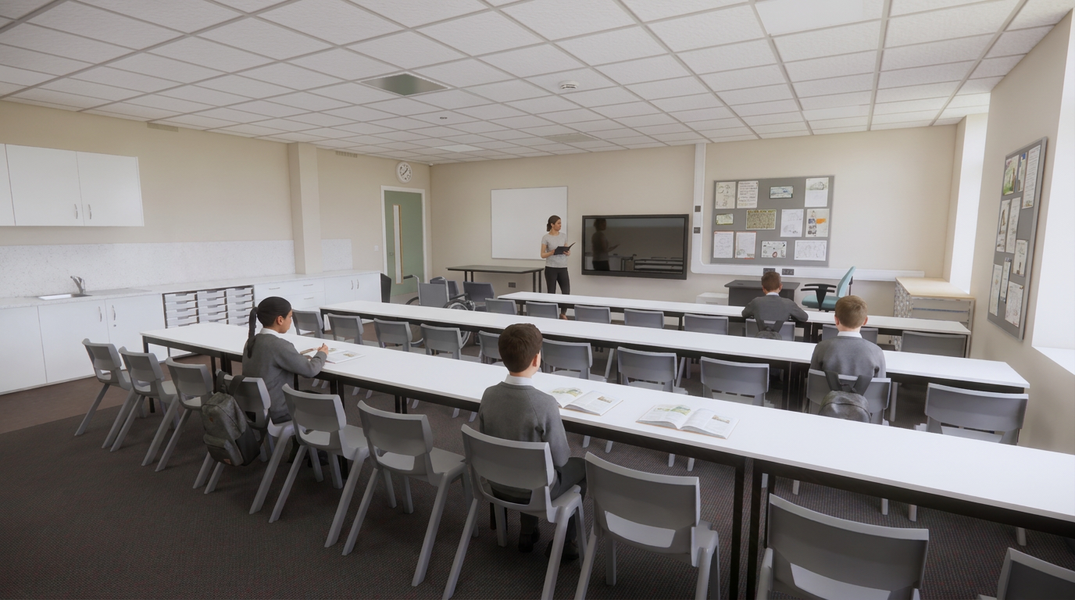
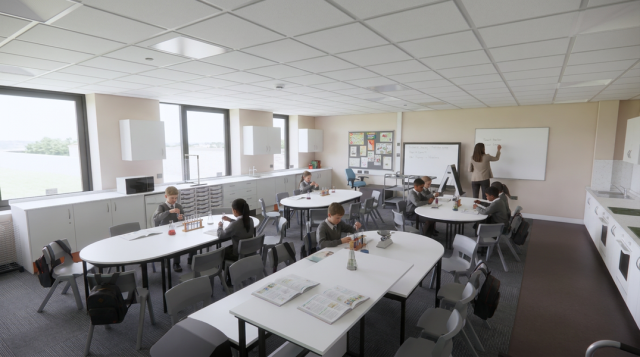
At the heart of the design is a focus on flexible, inclusive learning. The new Greenway Junior School will provide 12 classrooms alongside an assembly hall, sports facilities, a library, a food technology room and a range of group rooms, supported by reception, staff workspace, kitchen and WC facilities.
A self-contained Special Educational Needs (SEN) suite forms a key element of the layout, offering dedicated learning accommodation with direct access to its own external play area. The scheme will also deliver a new access road and additional parking to serve the neighbouring nursery, while the external areas will include dedicated teaching spaces, a new playground, a multi-use games area (MUGA) pitch and a playing field, creating a wider landscape for learning, recreation and physical activity beyond the classroom walls.
Fossil-fuel-free heating at the core of the low-carbon design
Sustainability sits at the centre of the scheme, which has been designed to achieve Net Zero Carbon in Operation in line with the Department for Education’s Output Specification 2021. The school’s heating strategy relies on air source heat pumps housed on the roof within an acoustic enclosure, supplying low-temperature hot water to radiant panels in the main hall alongside hybrid ventilation units with heat recovery in classrooms. Together, these systems are intended to maintain thermal comfort for pupils and staff while significantly reducing the building’s operational energy demand.
Renewable energy generation will come from a bio-solar roof system incorporating photovoltaic panels, while the wider landscape strategy includes sustainable drainage measures such as swales, permeable paving and attenuation basins. These features are designed to manage surface water on site and ease pressure on the local sewer network. The scheme has also been designed to deliver a four per cent Biodiversity Net Gain, embedding ecological considerations into the site from the outset rather than treating them as an afterthought.
To support the low-carbon ambitions of the project, Morgan Sindall is using its proprietary digital carbon assessment tool, CarboniCa, to inform carbon reduction measures throughout the design process. The platform will also be used once the project completes to audit actual carbon performance during construction, giving the team a means of measuring the scheme’s real-world results against its original targets rather than treating sustainability purely as a design-stage consideration.
Wider social value for Horsham
Beyond the physical building, the project has been structured to deliver tangible benefits for the wider Horsham community. Morgan Sindall Construction will provide 60 hours of engagement with local schools to showcase careers in construction, while supporting four apprentices and four T Level placements over the course of the build. The team will also offer ten work experience placements and dedicate 80 hours to helping local people access employment opportunities, alongside a further 84 hours of volunteering to support community initiatives in the area.
This emphasis on social value reflects a wider shift across the construction sector, where major public sector contracts increasingly require contractors to demonstrate lasting community benefit alongside technical and environmental performance.
Guy Hannell, area director for Morgan Sindall Construction in the Southern Home Counties, said: “Greenway Junior School will give pupils a modern, sustainable learning environment built with their needs, and the local community’s, front of mind.
“From the dedicated SEN facilities to the fossil-fuel-free heating system, every single part of this project has been designed to last well beyond the day the doors open. We’re incredibly proud to have been appointed and look forward to getting started on site.”
Part of a wider trend towards Net Zero schools
The Greenway Junior School appointment adds to a growing list of Net Zero Carbon education projects delivered by Morgan Sindall across England and Wales. The contractor recently completed Buntingford First School in Hertfordshire, recognised as the first school in England to be net zero carbon in both construction and operation while also achieving Passivhaus certification, and has delivered similar low-carbon schools in Essex and Buckinghamshire using modern methods of construction and air source heat pump technology.
As the Department for Education continues to roll out its School Rebuilding Programme, projects such as Greenway Junior School illustrate how sustainability, inclusivity and community benefit are increasingly being designed in from the outset, rather than added as an afterthought once construction is underway. With fossil-fuel-free heating, on-site renewable generation and a purpose-built SEN suite, the new Greenway Junior School has been positioned not just as a place to learn, but as a long-term asset for Horsham as a whole.
Work is expected to begin on site shortly, with the existing school continuing to operate throughout the early phases of construction before pupils and staff transition into the new building ahead of the demolition of the old site.