

HS2 reaches a milestone in the Chilterns
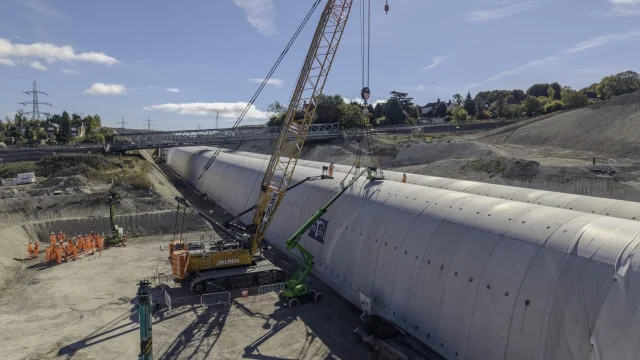
HS2 has completed the central section of the Wendover green tunnel in Buckinghamshire. Engineers have linked the two halves of the structure for the first time. The site team signed their names on the final precast concrete segment before a crane lifted it into place in October 2026.
The achievement shows how large infrastructure projects deliver results one stage at a time. It also highlights the skill and financial backing that contractors need to complete work of this scale.
What has been built at Wendover?
The tunnel runs for around 1.4 kilometres to the west of Wendover, alongside the A413. Builders used 2,740 precast concrete segments to create an M-shaped structure. The shape gives northbound and southbound trains their own separate halves.
Each segment weighs between 16 and 40 tonnes. Stanton Precast makes them in Ilkeston, Derbyshire, and lorries carry them to the site. EKFB leads the construction. This joint venture of Eiffage, Kier, Ferrovial Construction and BAM Nuttall delivers HS2’s central section through Buckinghamshire and into South Warwickshire.
The team built the central section in two parts. This approach let crews prepare the ground, install segments and backfill at different points at the same time. It kept the programme moving.
HS2 Ltd’s project manager, Umesh Gorasia, welcomed the progress. He said: “It’s great to see the two halves of the tunnel linked up for the first time. Once complete, the green tunnel will dramatically reduce disruption from passing trains and blend the railway into the countryside.”
He added: “There’s still some way to go, but we’re making good progress and I’d like to thank the team for all their hard work.”
Why did HS2 choose cut and cover?
Most people think of HS2 tunnels as deep bores driven by huge machines. Wendover is different. Engineers dug a wide cutting, built the tunnel inside it and then replaced the earth on top. This method is known as cut and cover.
The decision to build a tunnel came during the Hybrid Bill petitioning process. The railway already sits beside the A413 and the London to Aylesbury line. Even so, the rolling chalk hills of the Chilterns made a covered route necessary. Local concern about the landscape also played a part. EKFB then had to find the best way to deliver it.
The tunnel is designed to reduce noise to local residents and also gives builders a practical way to restore the landscape. Crews excavated more than 1.2 million cubic metres of material, mostly chalk, to create the level base. They stored it on site and are now returning it around and above the structure. Once the planting matures, the railway should blend into the countryside.
The “green tunnel” label comes from this finished look. The structure cuts noise for nearby residents and protects the surrounding green space. HS2 will use five of these tunnels between London and Birmingham. The others are at Chipping Warden, Greatworth, Burton Green and Copthall in Hillingdon. Copthall finished earlier this summer.
The engineering challenges
The site is narrow, and that created a logistical puzzle. There is little room to store heavy segments, so lorries must deliver them just in time for lifting. Crews also had to share the cutting with an internal haul road. Dump trucks use it to move chalk along the route without joining public roads.
Groundwater added another test. Half of the tunnel sits in the water table. Engineers built a low-permeability wall to stop the cutting from flooding.
Backfilling demands equal care. The segments do not connect mechanically. They rely on their shape to hold position. Engineers remember the Gerrards Cross tunnel collapse in 2005 and have applied the lessons. Machines working above the tunnel may weigh no more than 12 tonnes. Crews must also keep the fill on either side within 250 millimetres of each other in height. This keeps the load balanced as the earth builds up.
The team also borrowed ideas from earlier tunnels. At Chipping Warden, crews learned to use pre-assembled reinforcement cages for the floor slab. This kept workers out of a very confined space. At Ellesborough Road, engineers used a self-propelled modular transporter on 16 sets of wheels. It lifted the temporary bridge beams from below and moved them into position.
What happens next at Wendover?
Work now turns to the portals at each end, the floor slab and the internal fit-out. Backfilling and landscaping will continue. The portals will have “porous” roof slots. These let air escape gradually and reduce tunnel boom, the loud pressure wave that fast trains can create at tunnel exits.
Earlier reports suggested the team hoped to finish assembly and backfilling by 2027. The rebuild of Ellesborough Road should follow around 2028 or 2029.
A busy month for HS2
The tunnel news follows another milestone further north. HS2 recently completed the Westbury Viaduct near Brackley. The 320-metre structure will carry trains across the River Great Ouse floodplain.
HS2’s senior project manager, Paul Cooper, praised the team. He said: “It’s been amazing to watch Westbury viaduct come together over the last few years and I’d like to thank everyone involved in getting this incredible structure over the finishing line.”
He continued: “This section of the railway is now really starting to come together, and with the viaduct complete, our focus will turn to completing the earthworks and other nearby structures.”
